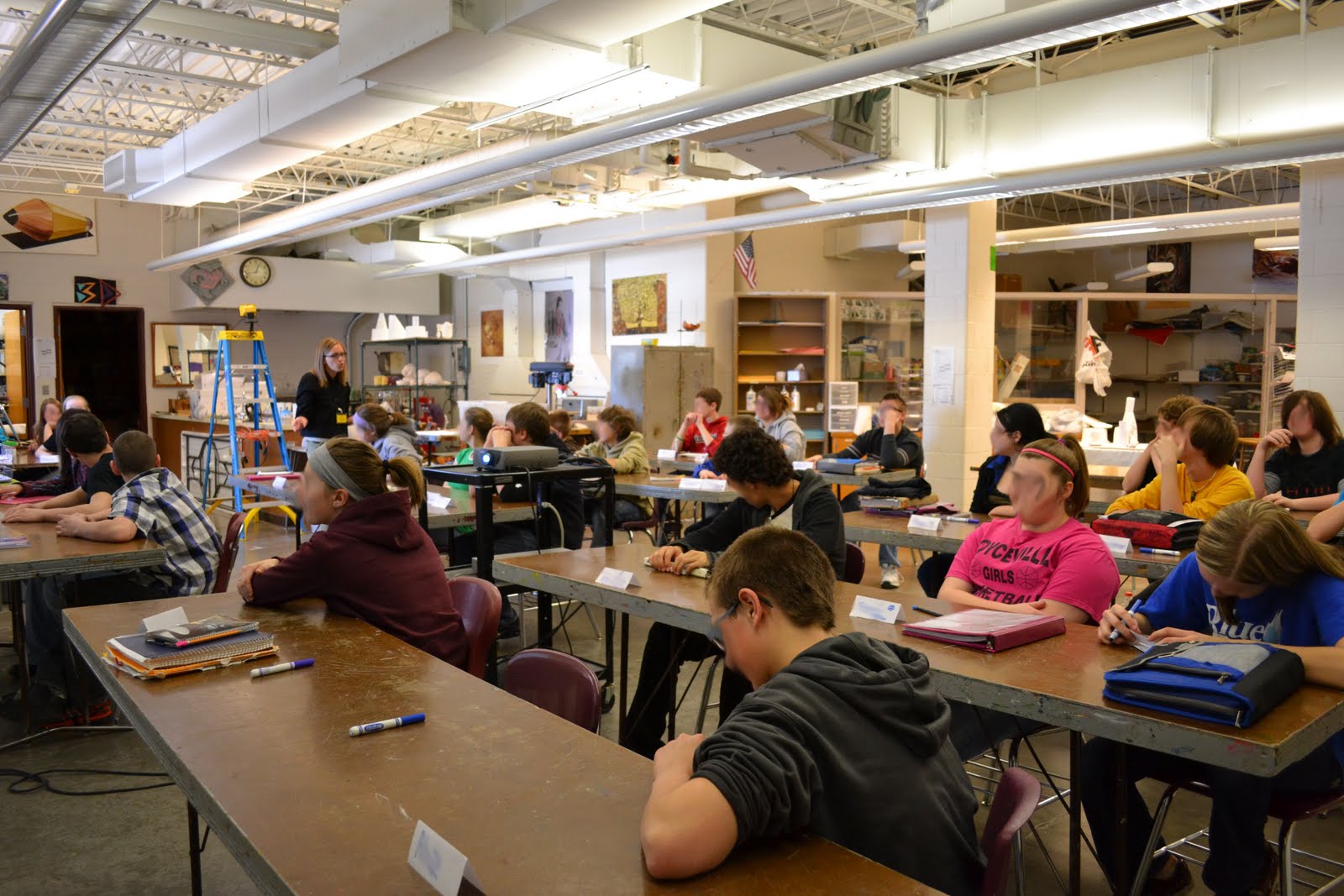
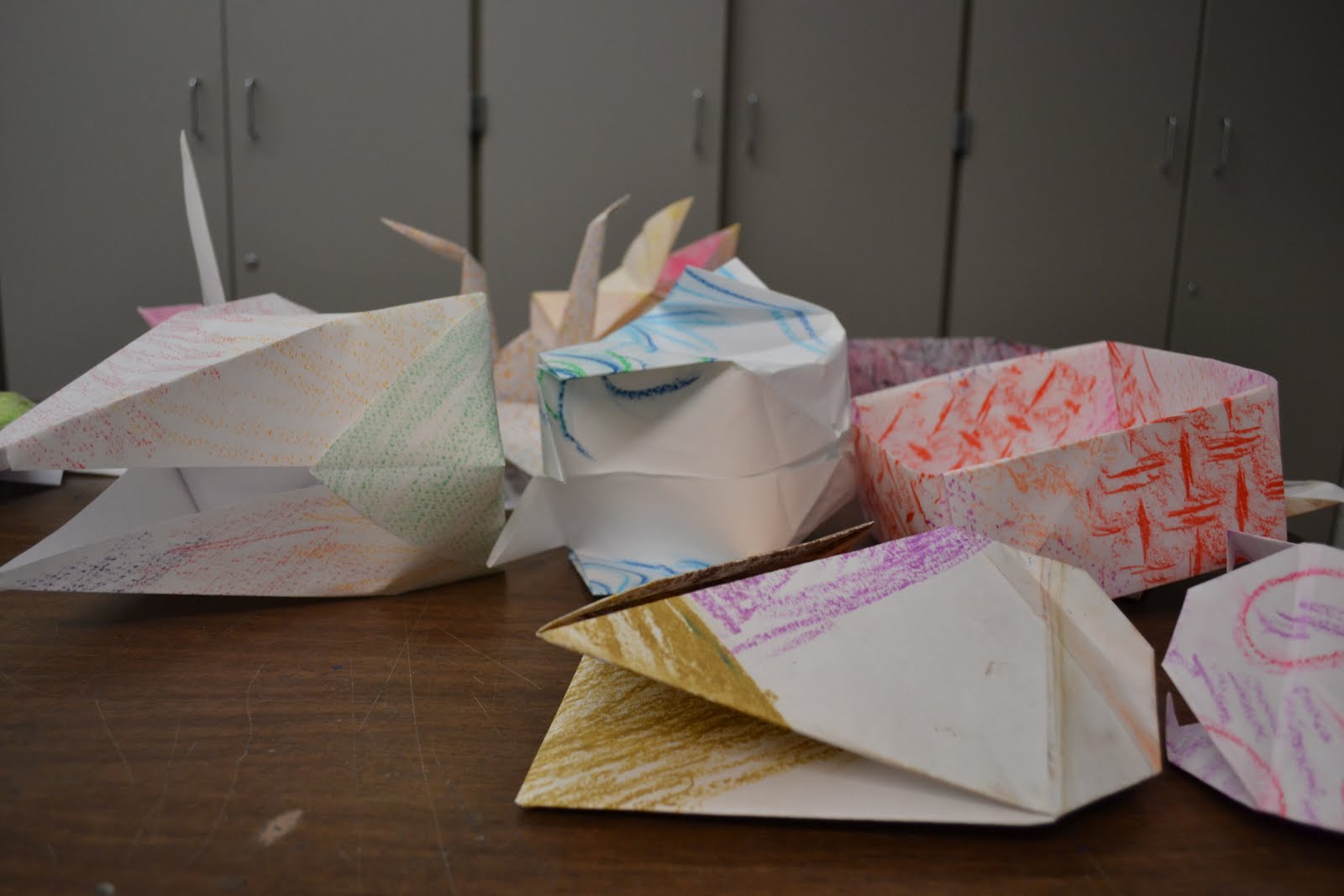
Today, a new group of students were coming into the art room because of the new quarter. The teacher went over the syllabus and made it clear that each student needed to sign the syllabus as if it is a contract that they will agree to. This is a good strategy in holding them accountable for their actions. It is extra credit if the parents sign it as well. This is a good way to get parents involved and let them know what is going on in their child's life. The teacher went over the basket and folder system of the classroom. She showed everyone where the folder was located with information about absences for each day. This system holds the students accountable for figuring out what they have missed on their own and taking the responsibility to make up for it. A PowerPoint was given about the projects that they will be working on throughout the semester. The students got the choice to decide which projects they want to do in what order by voting. This made them feel like they were an important part of the class and that they had an opinion about what goes on. This, again, holds them even more accountable for their choices and actions. Origami, Ribbon Drawing, and Clay Containers were the projects that they had to choose from, which I have already experienced in the prior semester. The teacher offered a description of each with photos of example projects. I like the idea of letting students have an opinion on scheduling of projects. I would definitely use this in my own classroom. Seating charts were then discussed, as well as the chat box. The students start out the semester sitting in their assigned seats. When they are well behaved, they can earn stars. If the class has two stars at once, they have free choice in seating. They can lose this privilege when they fill up the chat box (if they are loud or poorly behaved). Each time the chat box fills, they lose a star. I do like this as a strategy and would try it out in my own classroom, but I would rather have an expectation for my students to be mature without the need for a system like this. I would make a seating chart and use it every day. If the students start the class with good behaviors, I would let them move during work time if they would desire to. If the students started showing signs of bad behavior, I would give them a warning. If it became too much to deal with, I would tell them that they would need to remain in their assigned seats for the rest of the period. I don't see the need to make a game out of following directions. This is a very large class and we actually ran out of chairs for all of the students. The classroom is very large, but there is not enough furniture to fill it. There are not enough tables for supplies and demonstrations either. It can get frustrating when there is nowhere to set things. There is a lot of shelving for projects, but very little work space. If I taught in this classroom, I would ask my principal how I can get more furniture, if possible. If there was no funding to get more furniture, I would likely make tables or buy some on my own, simply because it is just very difficult to teach art with little work space. After the teacher went through the syllabus and classroom procedures, the students began a basic project. Each student would have a piece of paper with their name on it. The papers would be passed around the classroom and each student would draw a line on every piece of paper. The result was an abstract drawing when the original owner of the paper got it back. The teacher and myself walked around the classroom watching over the students as they drew and passed. The teacher noticed that a student had been drawing inappropriate things on the papers. She immediately told everyone to put their heads down for the rest of the period. The papers were collected and thrown in the garbage. Many students had not understood why they were being punished. The teacher took the particular student aside who was drawing the inappropriate images and sent him to the office. After a few minutes, the teacher announced that inappropriate images should not be used in any project for school. She had the students keep their heads down for the remainder of the class. I would have handled this situation very differently, although I do understand why the teacher reacted so severely. What happened is completely unacceptable. I would have collected the inappropriate drawings and had the students start over. It would be announced to the entire class that inappropriate imagery is unacceptable. After discussing this, I would have the students start fresh, knowing the consequences of it being repeated. At this point, I would remove the student who was drawing inappropriately. I would sit down with the student and address the situation and punishment, as he is the culprit. I would not punish the rest of the class for something they did not do. It is a good learning experience for the rest of the class for it to be addressed as a whole, but the punishment should be dealt with privately. The principal would be my last resort in terms of dealing with the situation. Talking through the situation with the student would be my first attempt. By sending the student to the principal, he became quickly angered and ended up lashing out at the principal, which then resulted in suspension. By keeping the situation in the classroom and dealing with the behavior immediately when the student was calm, I think this could have been prevented. If the situation did not go as well as I had expected, I would then either escort the student to the principals office or have a staff member escort him.
The students were still working on their ribbon drawings today. They were given a piece of drawing paper, and they were expected to draw six different ribbons with different curls and angles. As I walked around the room and watched them work, some of the students were having trouble just making an outline of a ribbon. They couldn't seem to grasp how a ribbon overlaps itself. When it came to the shading of the ribbons, they seemed to understand that the underside of curls would typically be darker than the exposed parts of the ribbons. The students were drawing blindly, as they did not have any visual examples of ribbons. If I were to teach this lesson, I would have put a section of ribbon at each table for them to reference if they became confused. They were still using the graphite drawing pencils, kneaded erasers, and tortillions. It was very enjoyable to watch them concentrate so hard on the light source and their variations between light and dark. I walked around the room and made comments and suggestions. If I noticed something that a student was doing particularly well, I made sure to let them know that they should keep up the good work. When I did constructively criticize a student's work, I made sure to tell them something that they were doing well, also.In between comments and suggestions, I talked with the teacher. She explained to me that she didn't necessarily like this project so much because it didn't leave much room for creativity. I told her that I thought it was good for the students to try something more technical for a change. I reassured her by saying that the projects she has assigned previously were very creative and that this project would balance it out.


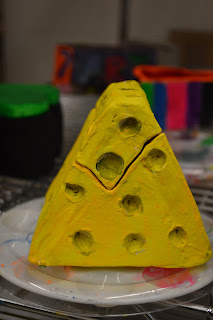 The students started out finishing up their written reflections about the origami pieces they were supposed to have finished. If they had not finished yet, each student was held responsible for taking the work home. They were also supposed to be finished with painting their clay containers at this point as well. If they had not finished, they were expected to come in during homeroom/study hall, or after school. They could not take these projects home because of the risk of breaking them and checking out paint supplies wold be unrealistic. Some of the best clay containers would be sent off to a contest in Menomonie. I think that doing this is a great way to get the community to see what is going on in the schools and is very exciting for the students as well. They seem to like the idea of people seeing the result of their hard work. Once the students had figured out whether or not they were expected to do work outside of class, the teacher moved onto a new project. They would begin the ribbon drawing project today. She introduced the project by starting out with a PowerPoint. It contained information about shading, value, shape versus form, and gray scale. It was very simple, yet informative. As the teacher introduced these subjects, she told the students not to be afraid of all of the technical aspects of the project. She told them that shading takes practice and she knows it can be scary, but do not get discouraged. She said that everyone will improve throughout this project and it will be good for them. During the PowerPoint, some of the boys were pretty rambunctious. The teacher had to stop a few times and wait for them to become quiet again. Overall, they were pretty well behaved, and by the end of the presentation, they were ready to get started. At this point, the teacher brought out the graphite pencils and explained the hardness and softness by drawing a scale on the board. This made it very simple for the students to understand what the different numbers and letters meant and what they were supposed to be used for. The teacher also went over how to use each kind of eraser. The students then had time to practice using the pencils. When the students were practicing with the pencils, she talked about tortillions or blending stumps. She also explained that they could use their fingers or paper towels to blend the graphite. I was very impressed with the speed and proficiency in her lesson. She also did a quick demonstration on how to create a gradient, which the students then emulated. All of these things were done in preparation for drawing the actual ribbons. The student were very excited to use special drawing pencils. The teacher did a great job of motivating them. Her enthusiasm for the project was reflected in the students. I hope to portray this kind of enthusiasm in my own lesson.


As the students came into the classroom, they got their supplies right away without being asked and took their seats when they finished. The teacher doesn't seem to consider the bell at all. It takes about three minutes for everyone to get settled, and then she begins with directions. The students are responsible for remembering what they were working on the day before and getting what they need to continue. As the students gather their things, the teacher scans the room to take attendance. She does not use a seating chart unless they get out of hand. The students were finishing up the painting of their containers today. Once the students had finished painting, they were expected to finish their level three final origami piece, if they hadn't done so already. I walked around and watched the students work, making comments and giving advice on occasion. They were so busy and deep in thought about whatever they were doing. Some students were making designs on paper with oil and chalk pastel before they folded it into their origami piece. Others were sharing paint pallets and helping each other mix colors. As I sat down next to the teacher, she commented that she loves it when the students are at this stage in their work. When they are this busy and content, she knows she did something right. I agreed and realized how rewarding it actually was to see them finally making origami on their own and experimenting with color mixing of paint and blending of pastels. As the teacher and I sat and talked, we discussed some personal things about spring break and current events. I took advantage of this conversation with her to find out about why she decided to become an art teacher. The discussion started out with me asking if she had considered a career involving art, but not in teaching. She went on to tell me about how art had changed her life when she was younger. She originally had a passion for art therapy, but decided that it was an unrealistic endeavor because of the schooling involved and the low demand for art therapy. Taking risks is not her thing, she explained to me. She felt as if it was a risk to do something other than teaching, since teachers have a steady job (or so she previously thought). Studio art was also a consideration, but as she explained, there is no stability in that endeavor. She wanted a job that was immersed in the arts, and being an art teacher was the solution. Now, she seems to be rethinking her career choices, and may look into other options. She really likes her job most of the time, but times are getting tough at this point. Enrollment in art class is also an issue at this school. The art teacher before her was choice based. The students were expected to take an introductory art course, and from there-on-out would be in advanced art. In advanced art, the students did whatever they wanted. It was completely open, and that is what the students got used to. When the current teacher came along, she ran the art room based on DBAE, for the most part. This was a huge transition for the students to get used to, and the high school students are still in revolt about it. They complain that they actually have to think and do things in art class now. The current teacher is unsure of what she should do, because enrollment in art is very low at this point, and this puts her job and the budget for art at risk in this school. Morally, she desires to teach discipline based art with some free choice thrown in. The community seems to want freedom in the art room. From my point of view, she has a good system going with a nice balance, which I told her. I explained that she gives the students reasonable assignments that are enjoyable. She also allows plenty of time for completion. Some of the lessons have been confusing at times, but we are all human and we learn from our mistakes. She is a young teacher, and she is still learning. Even the seasoned teachers out there still have a lot to learn. It was very disappointing for me to hear that the community doesn't appreciate her endeavors. Also, I noticed that this group of 8th graders seem to love art class. They are happy to be there. But, the teacher explained that the high school students are a different story, because the had the previous art teacher when they were in middle school. The transition is still a problem. The students clean-up pretty well. When they are done, the teacher asks them to return to their tables and wait until the entire room is clean. If the bell rings, she ignores it. They all get to leave when everything is finished. As of now, I will be teaching my lesson on March 21st and march 23rd. I am looking forward to it!


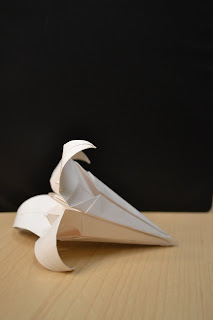 The students were finishing up the origami unit today with one last project from their booklets. It was a level three project, and if they were advanced, they were allowed to move on to the level four project if they felt individually capable. As usual, the teacher folded a piece of paper in front of the classroom and went through the steps so the students could follow. There were students that got off track again as I worked my way around the room and assisted them. This particular project was a Lilly, and it was much simpler than the other level three projects they had been doing before. This made my job a bit easier, because there was a lot less confusion. The students got through the project in a timely manor and were happy with the end results. Many of the girls were so excited about their paper flowers that they put them in their hair. There was some scented lotion in the room and some of the girls put lotion from their hands into the center of the flower to make it smell good. The guys didn't seem to appreciate this project as much as the others, but they did male oriented projects on other days to make sure that everyone enjoyed at least one of the origami projects. When they had finished the origami unit, the teacher began explaining how they would be painting their ceramic containers from a couple of weeks before. She explained how they were at the bisque stage and were ready to apply paint. She brought the students into the back room where the acrylic paint is kept (it surprised me that they would be using acrylic paint instead of glaze). The teacher explained that they had to be careful with their use of the brushes and only take a small amount of paint at a time. Their resources were limited, since they only had so many palates and needed to share between each table! Their painting resources are very limited. She also showed them how to dust off their bisqued pieces before applying paint. Then, she took all of the students over to the sink and showed them how to properly clean a brush (warm or cool water, soap, and brushing motion over the palm of the hand). There were some brushes in the room that were not properly cleaned out, and she showed them what not to do with this example. When the explanation was over, the teacher dismissed the boys to dust off their pieces and the girls to get their paint. Then they switched (to avoid chaos). This system worked well. I positioned myself in the paint area to make sure that the student knew what they were doing and stayed to help them if needed. Once the students knew what they were doing, the teacher and I talked for a bit. I asked her about the lesson that I will be teaching in the near future, and she is very flexible. I suggested that I could teach something involving drawing, since the supplies of this class are quite limited. She said that sounded like a good idea because the paint resources are very limited and can be very chaotic to use appropriately. Also, the students are moving into a drawing unit, with ribbon drawing to start them off. She said that I could use two days to teach my lesson and it doesn't matter if it interrupts one of her projects. I really appreciate her flexibility and openness. Since the idea of layoffs are still fresh, I felt it inappropriate asking her why she became an art teacher. Instead, I asked her about the principal observing her. She told me that he had observed her just last week during her drawing class. It is a regular occurrence that she is observed by the principal. I found this to be unusual, since the other teachers I have worked with very rarely are observed. She didn't seem to mind that he was observing her, but it does seem a little nerve wracking to me. I also asked her if she turns in her lesson plans to the principal. She said that there is a monthly outlook of her lesson plans that she shows the principal, but other than that it is pretty relaxed. The other district that she had previously worked for asked for a weekly plan. She told me that it is pretty rare to find a school that asks for all of your lessons. The students were busy painting their containers. During her talk, the teacher discussed mixing colors with the students and explained how using color straight from the tube is not the best option. It was disappointing to see that most of the students were in fact using the colors straight from the tube. I think the main reason for this is that the students only had about ten minutes to paint before class was over, and they felt rushed. The teacher did tell them that they could save their colors until tomorrow with plastic wrap, but they still seemed to rush through things. As they painted, the teacher and I began talking again. She apologized for being "so crabby" lately, and I simply said that I understand why she is upset with everything that is going on recently and that I realize it is a lot to take in. She talked to me about how a layoff could affect her and her family and personally opened up a bit. It was very hard to hear, knowing that many people are going through the same thing right now. Politics aside, the possibility of a layoff and the personal consequences of it on her are heartbreaking. I was happy to listen to her and hear her out, as I can only imagine her stress level. It was time for the students to clean up, and we monitored to make sure the everything was put away and clean before they left. One thing I have noticed that works well in this art classroom is that the teacher dismisses the students, not the bell.
 Teacher Made Example
 Supplies Table

 Criteria